Owning a home is often described as the American dream, but that dream relies entirely on the structural integrity of the slab or basement beneath your feet. In 2026, foundation health has become a focal point for homeowners as shifting climate patterns and volatile soil conditions put more pressure on residential structures than ever before. Whether it is the expansive clay of the South or the freeze-thaw cycles of the North, water and soil movement are relentless.
Understanding the cost of foundation repair is critical because these projects are rarely “optional.” A foundation issue is a progressive problem; it never improves on its own and only becomes more expensive the longer it is ignored.
By 2026, labor and material costs have stabilized somewhat following the post-pandemic surge, but professional intervention remains a significant investment. Being proactive doesn’t just save your home’s structure—it saves your home’s equity.
The National Average and Realistic Price Ranges
As of early 2026, the national average for foundation repair sits at approximately $5,200. However, this “average” can be misleading because foundation projects are rarely one-size-fits-all. Most homeowners find themselves paying in a typical range between $2,200 and $8,500. For minor maintenance, such as sealing a few non-structural cracks with epoxy, you might spend as little as $400 to $1,000.
On the other end of the spectrum, major structural failures that require the home to be lifted or stabilized with deep piers can easily climb into the $20,000 to $40,000 range. Because the foundation is the most labor-intensive part of the house to access, a significant portion of your invoice—often 50% or more—is dedicated to the specialized labor and heavy machinery required to reach the problem area.
Regional Cost Variations Across the U.S.
Geography plays a massive role in your final bill. The type of soil your house sits on determines the type of repair needed. In the South and Midwest, where expansive clay is common, foundation “settling” is a frequent issue. In the Northeast, older stone foundations often face moisture-related crumbling.
- Southern States (e.g., Texas, Florida): Costs typically range from $2,100 to $7,200. Slab foundations are common here, and “slabjacking” is a frequent, cost-effective solution.
- Midwest and Plains (e.g., Kansas, Ohio): Expect to pay between $2,500 and $8,500. These areas often deal with basement wall bowing due to hydrostatic pressure.
- Northeast and West Coast (e.g., New York, California): Prices are higher, ranging from $3,000 to $10,500+. High labor rates and strict seismic building codes in the West drive these costs upward.
Breakdown of Major Repair Methods
The “how” of the repair is the biggest factor in the “how much.” In 2026, contractors utilize a variety of technologies to stabilize homes without having to replace the entire foundation.
- Piering or Underpinning: This is the most permanent and expensive fix. It involves driving steel or concrete pillars deep into the earth to reach stable soil or bedrock.
- Cost: $1,000 to $3,000 per pier. A typical home may need 8 to 12 piers, totaling $8,000 to $36,000.
- Slabjacking (Mudjacking): For sinking concrete slabs, a grout or foam mixture is pumped underneath to “float” the slab back to level.
- Cost: $1,000 to $3,500 per area.
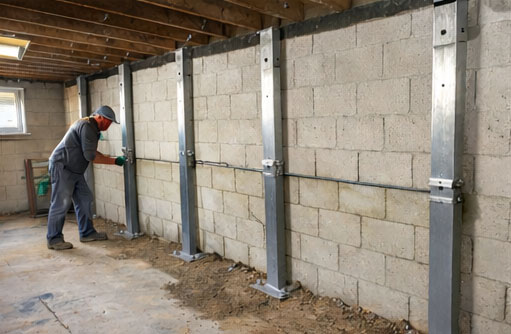
- Wall Reinforcement: If basement walls are bowing inward, carbon fiber strips or steel I-beams are installed to halt the movement.
- Cost: $4,000 to $12,000 for a standard basement wall set.
Essential “Hidden” Costs to Budget For
When you receive a quote for foundation repair, it often covers the structural work but may leave out the necessary “peripheral” expenses that ensure the fix actually lasts.
- Structural Engineer Report: Most reputable contractors require an independent engineer to sign off on the plan. This costs between $400 and $800.
- Soil Reports: For severe sinking, a geotechnical engineer might need to test soil density, adding $1,000 to $3,000 to the project.
- Building Permits: Municipalities in 2026 have tightened regulations; expect permit fees to range from $75 to $250.
- Landscaping Restoration: Excavation often destroys flower beds or decks. Budgeting an extra 10% of the project cost for yard repair is a wise move.
The Financial Risk of Procrastination
The most expensive mistake a homeowner can make in 2026 is waiting for “next year” to fix a known issue. Foundation problems are exponential. A $500 crack today is a window into the soil; left unaddressed, that crack allows water to seep in, which erodes the soil, which leads to settling, which eventually requires a $20,000 piering job.
- Compounding Damage: A shifting foundation eventually breaks plumbing lines under the slab, leading to “slab leaks” that add thousands in plumbing repairs.
- Resale Impact: You cannot legally hide foundation issues when selling. Homes with unrepaired foundations often sit on the market 50% longer and sell for 20% less than their market value.
- Inflationary Pressures: While material costs have steadied, specialized labor for foundation work is in high demand, and wait times can drive prices up if you need an “emergency” fix.
Protect Your Home’s Value by Acting Before the Shift
In the real estate market of 2026, a solid foundation is the ultimate “standard feature” that buyers expect. While spending $5,000 to $15,000 on something you can’t even see might feel frustrating, it is the most effective way to “lock in” your home’s appraisal value.
Foundation repair isn’t just a fix; it’s a transfer of risk from your wallet to a permanent, warranted structural solution. If you’ve spotted a new crack or a sticking door, the best time to call a professional was yesterday—the second best time is today.
Check Foundation Repair Contractor for more information.